Kernels for fixed-vector input
These kernels handle fixed vector input, similar to a fully-
connected NN. To use one of these, when initializing the
model, set kernel_choice = 'kernel name', e.g.
kernel_choice = "RBF".
Kernel Name |
Description |
kernel_settings |
|---|---|---|
RBF |
Models smooth, infinitely differentiable
functions; good default.
|
“intercept”:bool
|
Matern |
Models “rougher” functions than RBF.
nu = 5/2 models twice differentiable functions,
nu=3/2 models once differentiable functions, nu=1/2
models functions that are not differentiable. These
kernels can sometimes avoid “concentration of measure”
issues encountered by the RBF kernel in high-dimensional
spaces.
|
“matern_nu”:float
“intercept”:bool
|
Cauchy |
A scale mixture of RBF kernels; models functions that
vary smoothly across multiple lengthscales.
This is a rational quadratic kernel with degrees of
freedom set to 1.
|
“intercept”:bool
|
RBFLinear |
The sum of a linear kernel and an RBF kernel. Models
functions that are close to linear but with some fairly
smooth “wiggles”. Use “intercept” to indicate if a y-
intercept should be fitted.
|
“intercept”:bool
|
Linear |
Equivalent to Bayesian linear regression.
Use “intercept” to indicate if a y-
intercept should be fitted.
|
“intercept”:bool
|
MiniARD |
Same as RBF, but rather than having one
lengthscale shared between all features,
applies different lengthscales to different
groups of features.
|
“split_points”:list
|
The Linear kernel is equivalent to Bayesian linear regression.
If intercept is False, it will be fitted without a y-intercept
(generally it is preferable to set intercept to True).
The MiniARD is an RBF kernel that assigns a different lengthscale
to different kinds of features. You might have data, for example,
where some features are one-hot encoded and others are real. If
so, you could use MiniARD and “learn” a different lengthscale for
each type of feature. Hyperparameter tuning for MiniARD is more
challenging than for most kernels because it has > 2 hyperparameters.
If you’re interested in using this kernel, see the Advanced or In-Depth
tutorials for more on how to tune it.
For MiniARD, supply a list under
kernel_settings when creating a model, e.g.::
my_model = xGPRegression(num_rffs = 2048, variance_rffs = 512,
                      kernel_choice = "MiniARD",
                      device = "cuda", kernel_settings =
                      {"split_points":[21,36])
The features in between two split points all share a lengthscale. In this
case, for example, features from 0:21 in the input would share one
lengthscale, features from 21:36 would share another, and features from
36: would share another lengthscale (0 and len(feature_vector) are automatically
added to the beginning and end of split_points). This technique can be
very powerful but also does make tuning more complicated and much slower,
especially if the number of lengthscales is very large, so use judiciously.
The lengthscales learned by MiniARD during tuning can be used as crude
measures of relative importance (larger = more important group of features).
The chart below illustrates how some of these kernels fit a simple toy dataset with a noisy sine wave, a noisy cosine wave, and a linear trend.
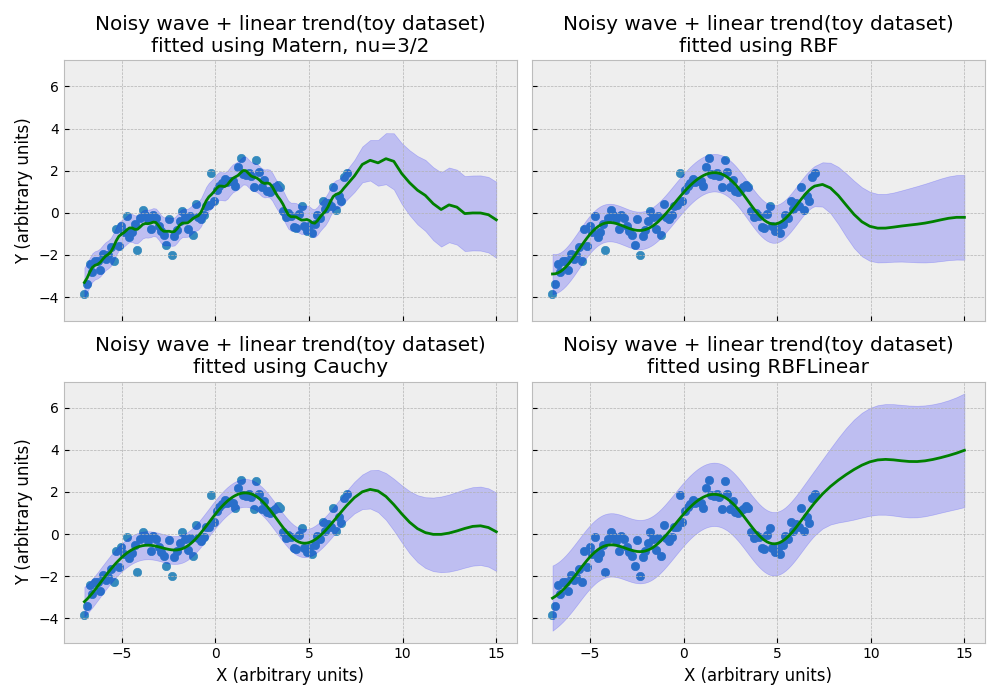
RBF assumes the functions you are modeling are extremely smooth (i.e. infintely differentiable), and when this assumption is true, it can achieve very good performance – indeed, RBF can model this toy dataset using just 8 - 12 RFFs. This is the classic “default” kernel. It computes the similarity of any two datapoints using
where sigma is a hyperparameter we will tune. Large values for sigma mean the function varies rapidly on very short lengthscales, while small values mean the function varies slowly over long distances.
Note that a Matern is somewhat “bumpier” even with nu=3/2; with nu=1/2, Matern is extremely “bumpy”, which may occasionally be useful but is not a good default. A Matern nu=1/2 kernel corresponds to a Laplace kernel, which measures similarity of datapoints using Manhattan distance (unlike Euclidean distance in the RBF kernel).
The RBFLinear kernel is the sum of a linear kernel and an RBF kernel
and assumes a linear trend. We only recommend RBFLinear if the number
of features in your input is relatively small, since the kernel will
produce num_rffs - input_shape[1], so that if the input has a large
number of features, you’ll need to set num_rffs quite high even for
initial experiments.
The Cauchy or rational quadratic kernel is a scale mixture of RBFs with different lengthscales. It measures the similarity of any two datapoints using
Generally exchanging RBF for Cauchy or Matern makes only a small difference in validation set performance – usually one of these kernels will perform better than the others but the gains are usually modest. If test set performance is your primary concern and you are not sure which kernel makes sense for your application, we recommend using the RBF kernel as a default, and potentially experimenting with the alternatives to see if they can provide some additional small gains.